

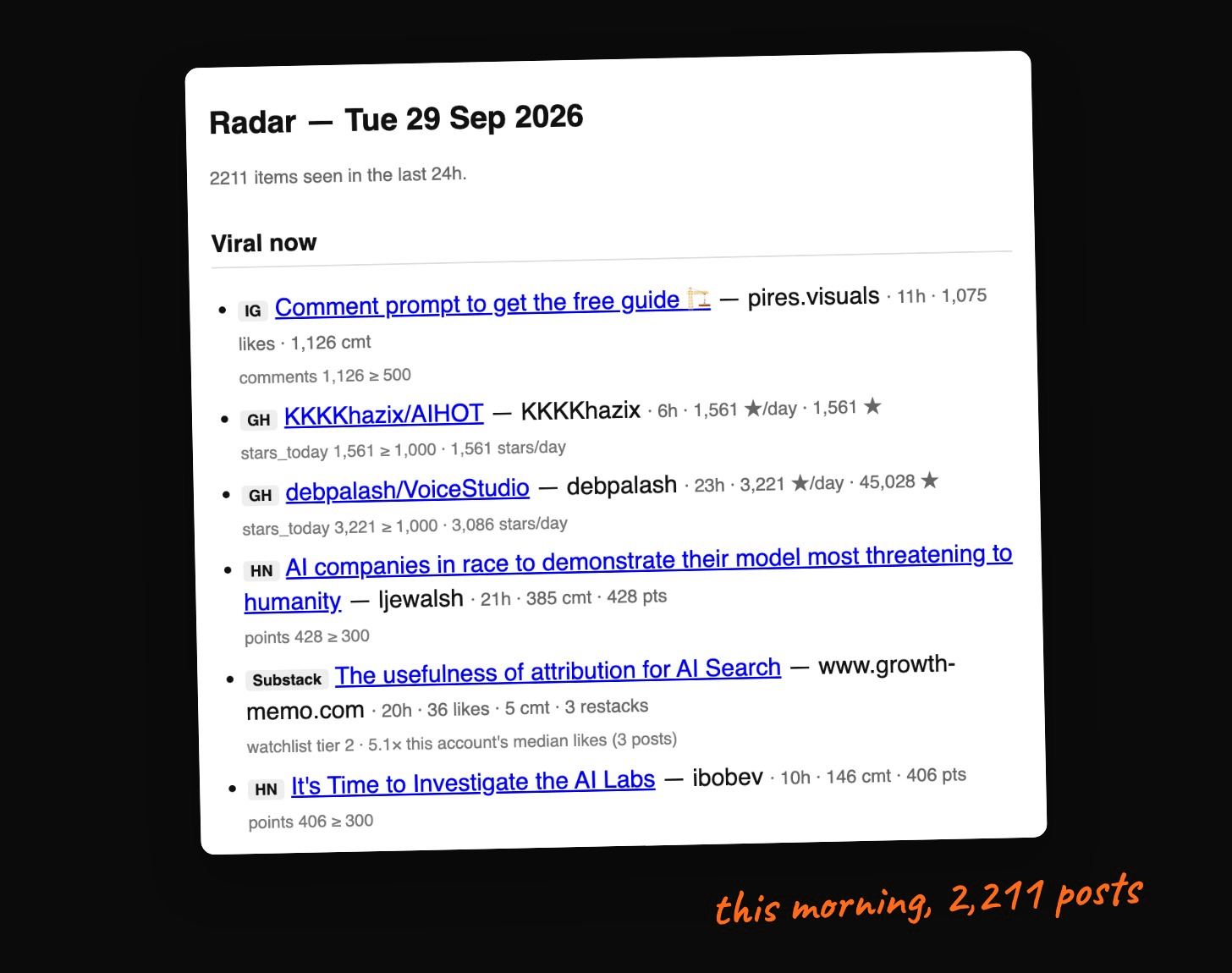
At 7:00 this morning an email landed with 2,211 posts in it.
I didn’t read 2,211 posts. I read one page, and it took about as long as my first coffee.
New here? Grab a coffee, you’re in the right place. Been here a while? Thanks for sticking around.
If someone on your team starts their day scrolling for ideas, forward this to them.
Today I’ll show you what that page is, where the posts come from and how it picks the few worth your time. At the end there’s a full setup guide if you want your own.
Why I built it
I post about AI every day, and I only post about tools I’ve actually tested. That means I need to know early what people are talking about, so I have time to try it before I write about it.
For months that meant opening Instagram, YouTube, GitHub and Substack every morning and scrolling until something looked interesting. It took close to an hour, and I still missed things that blew up on accounts I don’t check every day.
So on 18 Sep I asked Claude Code to build me something that does the scrolling for me. The first email came the next morning, and today’s was the eleventh.
What it reads
Every hour, at seven minutes past, my laptop runs a check. Each source has its own pace, so it isn’t asking YouTube the same question 24 times a day.
It reads new videos from the YouTube channels I follow, plus a search for AI marketing topics. On GitHub it looks for repos that gained the most stars in a day, and new releases from tools I use, like n8n and Claude Code. It reads the Hacker News front page, Product Hunt’s AI launches and the Technology and Business leaderboards on Substack.
It also reads my own Instagram and Threads, through my own login, plus 22 hashtags. And it watches the release notes pages of tools like OpenAI and fal.ai, so I know the day something changes.
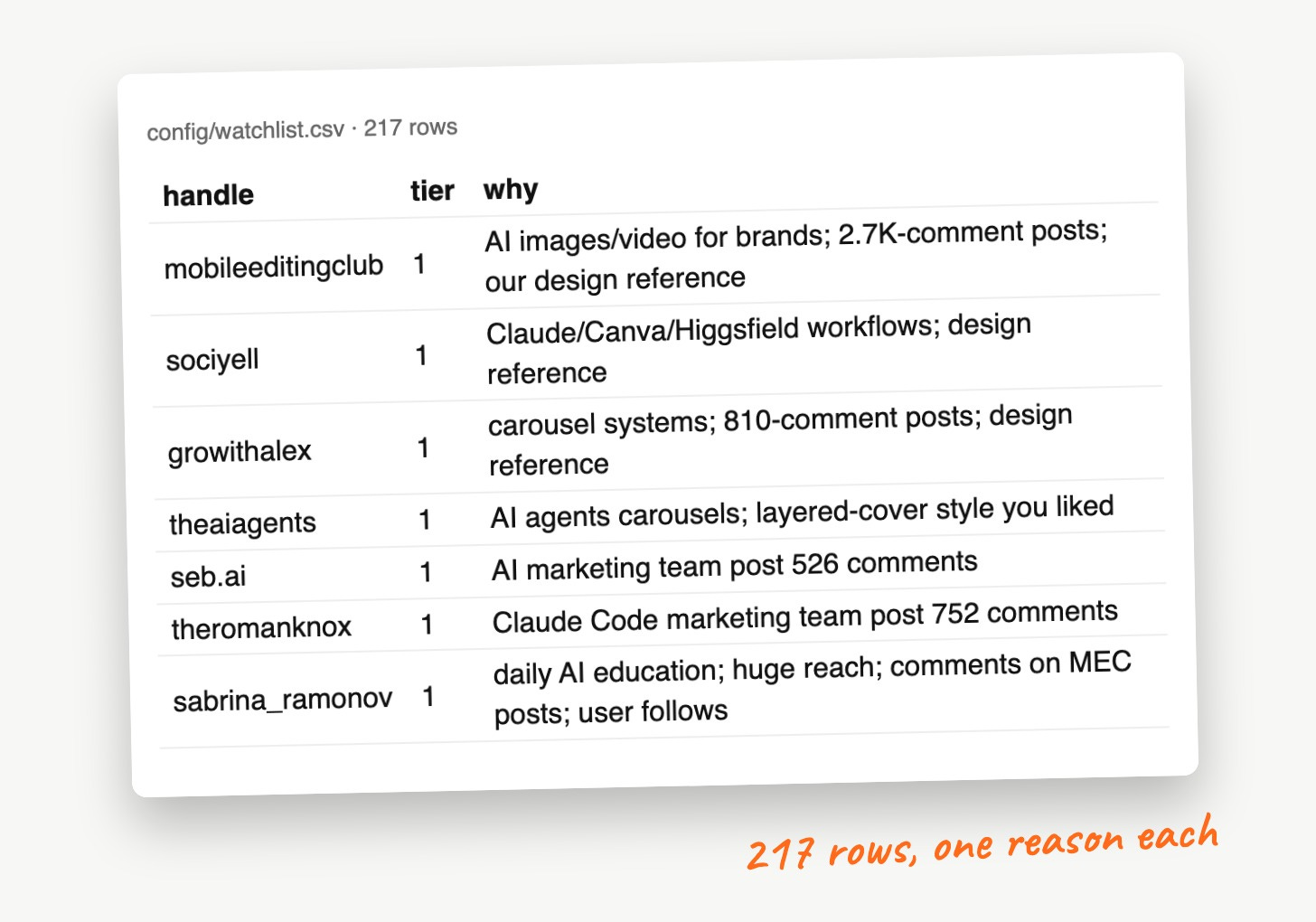
The accounts come from one spreadsheet with 217 rows. Each row has the platform, the account, a tier from 1 to 3 and one line on why I follow it. That last column ended up being the most useful one, because when an account shows up on the page, it reminds me what I’m looking for.
Everything lands in one database file on my laptop. In 11 days it has saved 6,044 posts, and more than half of them (3,294) come from Instagram. Every time the radar sees a post again, it updates the views, likes and comments, so the numbers are never more than an hour old.
How it picks what’s worth reading
Most of those 6,044 posts are normal, so the radar uses two rules to find the ones that aren’t.
The first rule is a fixed bar. A YouTube video needs 100,000 views, a GitHub repo needs 1,000 new stars in a day and an Instagram post needs 500 comments. A Hacker News story needs 300 points, and a Substack post needs 500 likes.
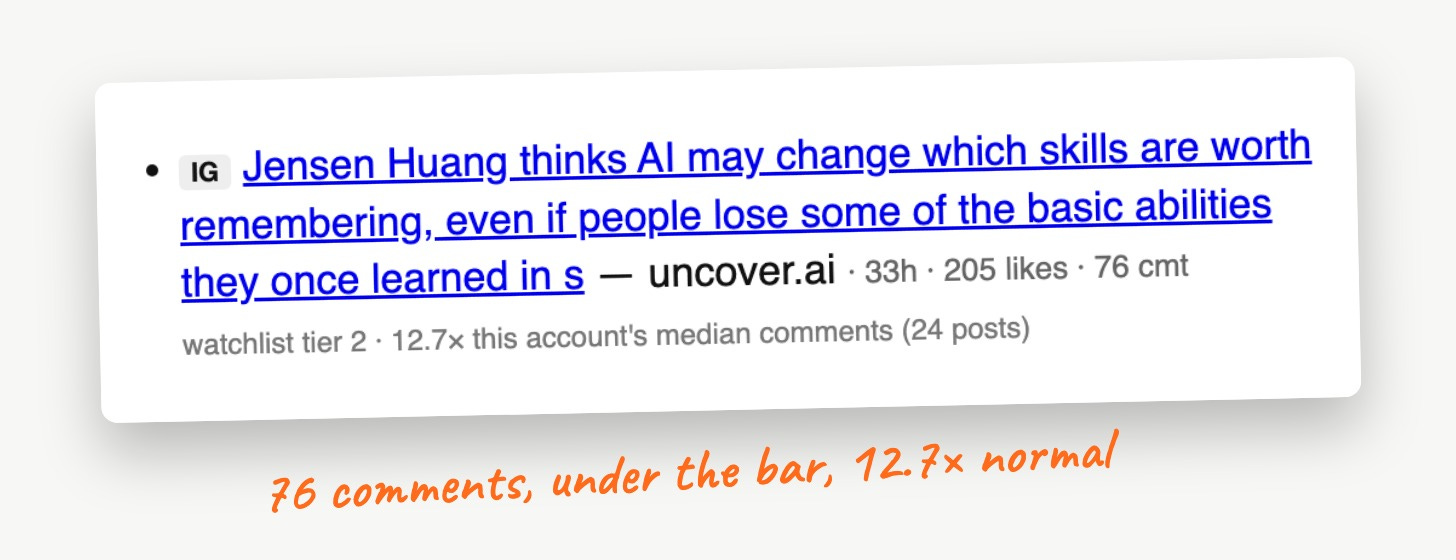
The second rule is the one I trust more. For every account on my list, the radar remembers what a normal post gets over the last 14 days. If a new post gets three times that, it goes near the top, even if the account is small.
This morning an uncover.ai post had 76 comments. That’s nowhere near the 500 bar, but the account usually gets about 6, so it was 12.7 times its normal and it made the page. The first rule would never have caught it.
Older posts count for less, so by day seven a post is worth half. Then the page is written in four parts: launches from the tools I use, posts over the bar, the accounts on my list and new names on the Substack leaderboards. At 7:00 it lands in my inbox.
What was on it this morning
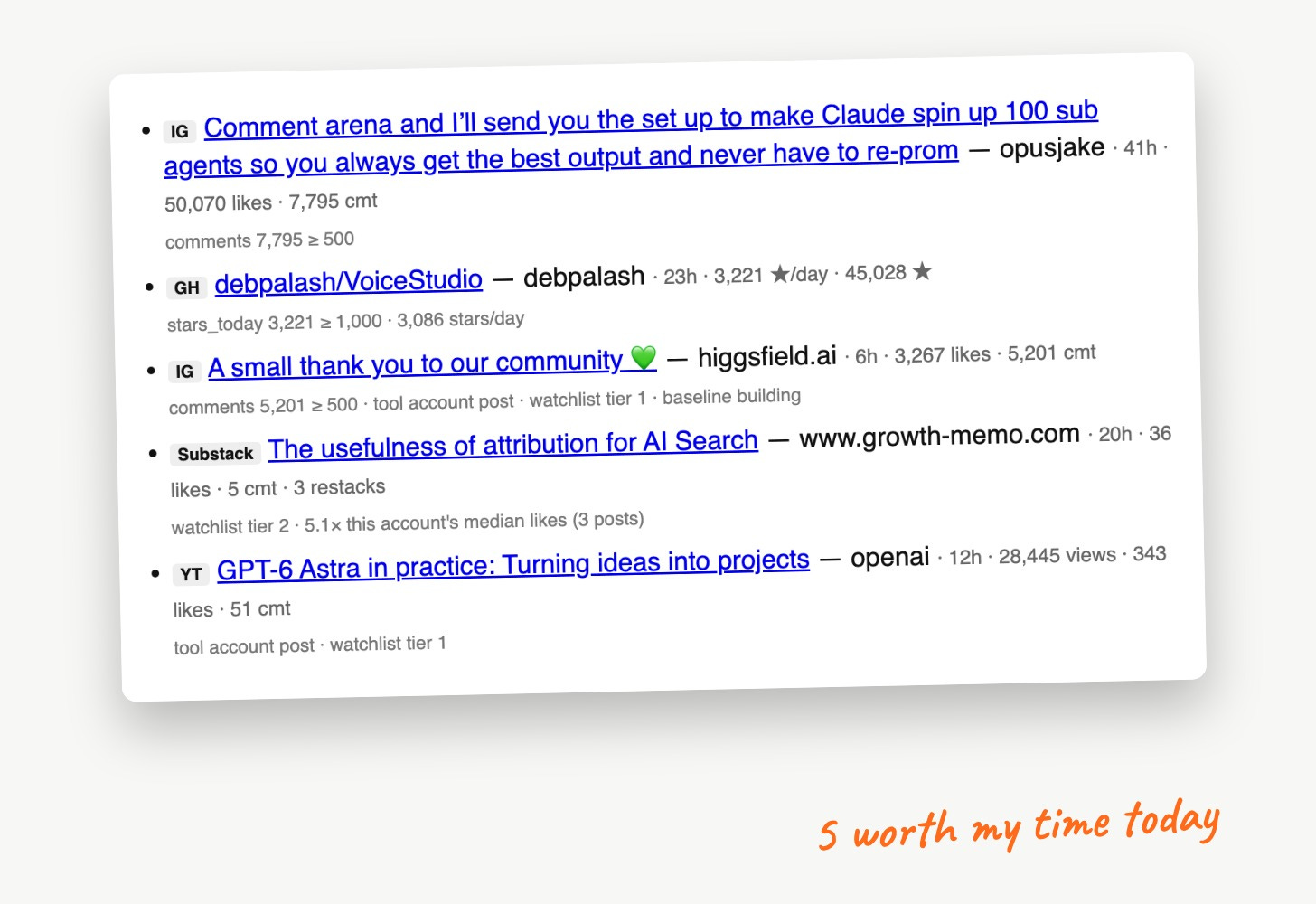
Five things made me stop.
opusjake, who’s on my list, posted how to make Claude spin up 100 sub-agents so you don’t have to keep re-prompting. It has 7,795 comments in under two days.
VoiceStudio, an open-source voice app on GitHub, gained 3,221 stars in a day.
Higgsfield’s own account posted a thank-you to its community, and it has 5,201 comments. It sat at the top of Launches, so I’m going to check what they shipped this week.
A Growth Memo post on attribution in AI search had 36 likes. That sounds small, but it’s 5.1 times what that newsletter usually gets, and that’s why it sat on the page next to posts with thousands.
And OpenAI put out a video on GPT-6 Astra in practice, plus an explainer on rogue AI agents. Both were in Launches.
I’m testing the sub-agents setup first, and if it holds up it’ll be next week’s post.
The whole page takes me about 10 minutes. The hour I used to spend scrolling now goes into testing the one thing worth testing.
How I know it’s working
The last part of every email is a short health list. Each source gets one line with “ok”, when it last ran and how many posts it found, so I can see at a glance that nothing is missing.
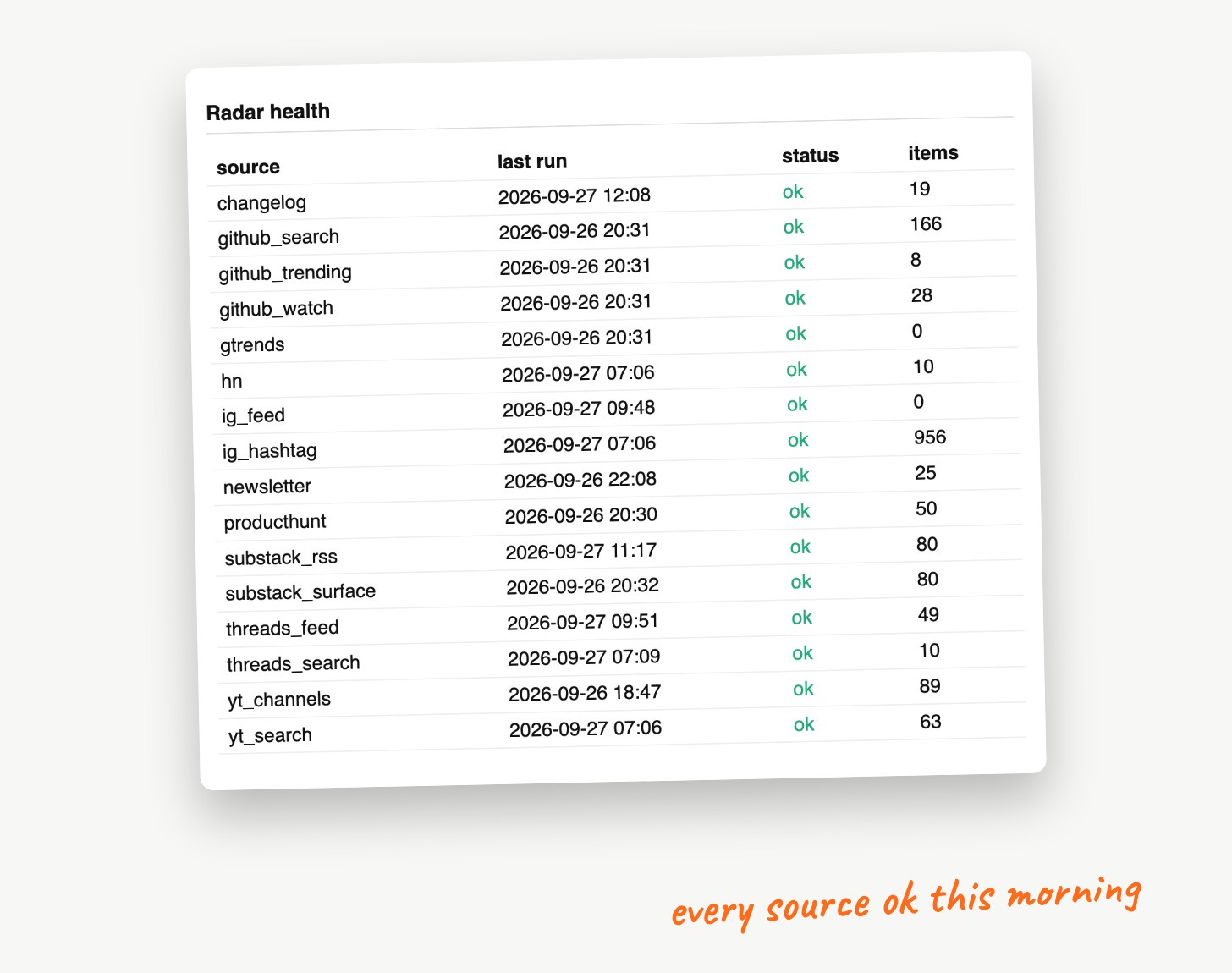
Instagram and Threads get a bit more care. The radar only reads my Following feed, one page at a time with random pauses, and it stops for the day the moment Instagram says “try again later”.
What it costs
Nothing to run. YouTube’s API, GitHub’s API, RSS and public pages are all free. YouTube gives you 10,000 units a day, and the radar uses about 1,300 of them.
I did look at a paid scraping service and decided against it. I’d rather have fewer sources I can check myself than pay for numbers I can’t.
Building it used my Claude subscription. The first version took one day, and since then I’ve added sources and small fixes as I needed them.
Build your own
I wrote the whole setup down as a step-by-step guide. It’s 7 prompts you paste into Claude Code in order, with a check after each one, so you know a step works before you start the next.
It covers the list, the database, the free sources, both rules, the 7:00 email and the schedule. There’s also an optional part for Instagram and Threads, with the rules I follow to keep my account safe.
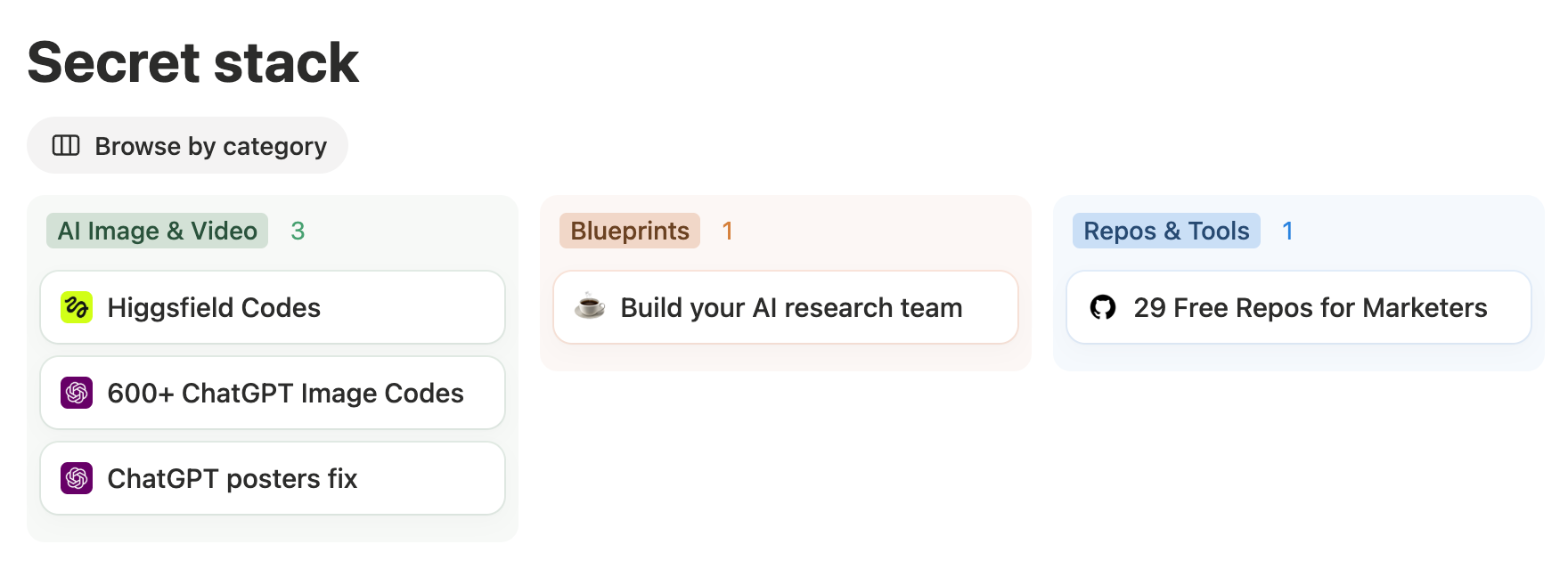
The guide is free for subscribers. Subscribe below and you’ll find the link in your welcome email.
Already subscribed? Reply to any Coffee First email with RADAR if you didn’t get it and I’ll send it to you.
If you only remember one thing
Start with the sources you already check by hand, and write one line on why you follow each account. Add the two rules, get one page at the same time every morning, and put a health line at the bottom so you know everything ran.
If someone on your team starts every day scrolling for ideas, forward this to them.
See you next week.
Aljaz